
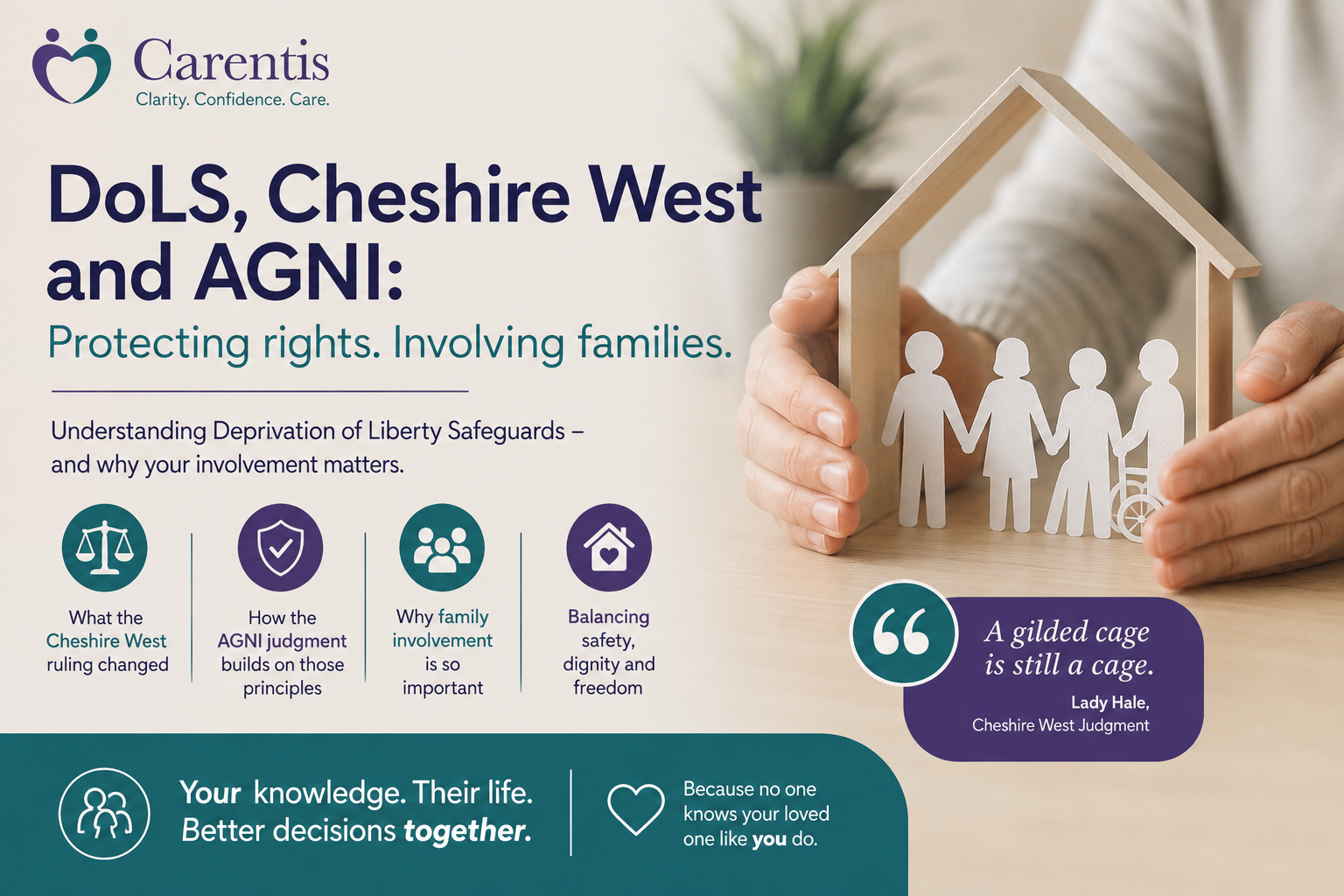
When someone moves into a care home, families often hear unfamiliar legal terms such as Deprivation of Liberty Safeguards (DoLS), Cheshire West, or more recently AGNI. It can sound as though the law is simply creating paperwork for professionals.

In reality, these legal decisions are about something far more important: protecting the rights of people who may no longer be able to make some decisions for themselves, while ensuring families have a meaningful voice in those decisions.
Understanding what these judgments mean can help families become confident partners in their loved one’s care rather than feeling excluded by legal processes.
What are Deprivation of Liberty Safeguards?
The Mental Capacity Act 2005 protects people who lack the mental capacity to make specific decisions for themselves.
Sometimes, keeping someone safe means restricting some of their freedoms. Examples include:
- Living in a care home they cannot leave independently.
- Having doors secured to prevent wandering into danger.
- Staff supervising them closely because they may be at risk.
- Medication or care interventions that the person cannot consent to.
When those restrictions become significant, the law may consider them a deprivation of liberty.
DoLS exist to ensure that any deprivation of liberty is:
- Necessary.
- Proportionate.
- In the person’s best interests.
- Subject to independent scrutiny.
- Open to challenge if circumstances change.
It is not about taking away someone’s rights—it is about protecting them.
The Cheshire West Judgment: The “Acid Test”
Before 2014, there was uncertainty about when someone was actually deprived of their liberty.
That changed with the Supreme Court decision in Cheshire West.
The Court created what has become known as the acid test.
A person is likely to be deprived of their liberty if they are:
- Under continuous supervision and control, and
- Not free to leave.
Importantly, it does not matter whether:
- The person appears happy.
- They do not try to leave.
- The placement is excellent.
- The restrictions are intended to keep them safe.
As Lady Hale famously explained:
“A gilded cage is still a cage.”
This transformed practice across health and social care.
Thousands more people were recognised as requiring DoLS authorisation because the focus shifted from why restrictions existed to whether they existed.
Then Came AGNI
The more recent AGNI judgment refined how professionals should think about deprivation of liberty.
Rather than focusing solely on whether someone meets the acid test, AGNI reinforced that professionals must carefully consider who is actually responsible for the restrictions and ensure decisions remain centred on the individual’s rights under the European Convention on Human Rights.
The judgment also highlighted something many families have long argued:
The person’s own wishes, values, relationships and history should never become secondary to organisational convenience.
Care providers should not simply rely on routine practices. Every restriction should be individually justified.
What Does This Mean for Families?
Families often worry when they hear the phrase “deprivation of liberty.”
Some assume it means:
“The care home has taken control.”
In reality, DoLS should provide reassurance.
It means there are independent legal safeguards ensuring someone is not unnecessarily restricted.
However, families remain incredibly important.
They often know:
- What the person would have wanted.
- Their lifelong routines.
- Their values and beliefs.
- Their likes and dislikes.
- How they communicate discomfort or distress.
- What makes them feel secure.
No assessment can replace decades of lived experience.
Why Family Involvement Matters
The Mental Capacity Act is built around person-centred decision making.
Professionals should actively consult those who know the person well.
Families may identify opportunities to reduce restrictions, for example:
- More community outings.
- Different visiting routines.
- Safer alternatives to locked areas.
- Assistive technology.
- Environmental changes.
- Familiar objects or activities that reduce distress.
Sometimes what appears to require restriction is actually unmet need.
Families often spot this before anyone else.
When Families Disagree
Occasionally families disagree with professionals.
Perhaps they believe:
- Restrictions are excessive.
- Their relative could safely have greater freedom.
- The care plan does not reflect their wishes.
- Decisions are being made for organisational convenience.
Equally, professionals may sometimes recommend restrictions that families find difficult to accept because of genuine safety risks.
Neither side should feel ignored.
The law expects consultation, transparency and evidence.
If concerns remain, DoLS provides formal routes to review or challenge decisions.
The Role of the Relevant Person’s Representative
Every person subject to DoLS should have a Relevant Person’s Representative (RPR).
This may be:
- A family member.
- A friend.
- An independent paid representative.
The RPR’s role is to:
- Stay in contact with the individual.
- Help them understand their rights as far as possible.
- Support them if they wish to challenge the authorisation.
- Ensure restrictions remain necessary.
Families should not see this as a symbolic role.
It is an important safeguard within the legal framework.
Can Restrictions Change?
Absolutely.
A DoLS authorisation is not a permanent decision.
If circumstances improve—for example:
- Mobility changes.
- Risks reduce.
- Behaviour changes.
- New support becomes available.
Then restrictions should be reviewed.
Families are often the first to notice these positive changes.
Good Care Is About the Least Restrictive Option
One of the core principles of the Mental Capacity Act is choosing the least restrictive option.
Good care homes constantly ask:
- Does this restriction still need to exist?
- Is there a safer alternative?
- Can this person have more choice?
- Are we promoting independence wherever possible?
The best care homes see DoLS not as paperwork, but as an opportunity to continually balance safety with dignity and autonomy.
The Bottom Line
The Cheshire West judgment fundamentally changed how deprivation of liberty is recognised, ensuring that people are protected even when restrictions are well intentioned. The AGNI judgment has reinforced the importance of individual rights, careful justification of restrictions and avoiding a one-size-fits-all approach.
For families, the message is clear: your involvement matters. You bring knowledge that no assessment can capture, and your perspective helps professionals understand the person behind the care plan.
The strongest decisions are made when care homes, health professionals and families work together. By combining clinical expertise with personal knowledge, it becomes much easier to strike the right balance between keeping someone safe and respecting the life they have lived, the choices they would have made, and the dignity they deserve.