
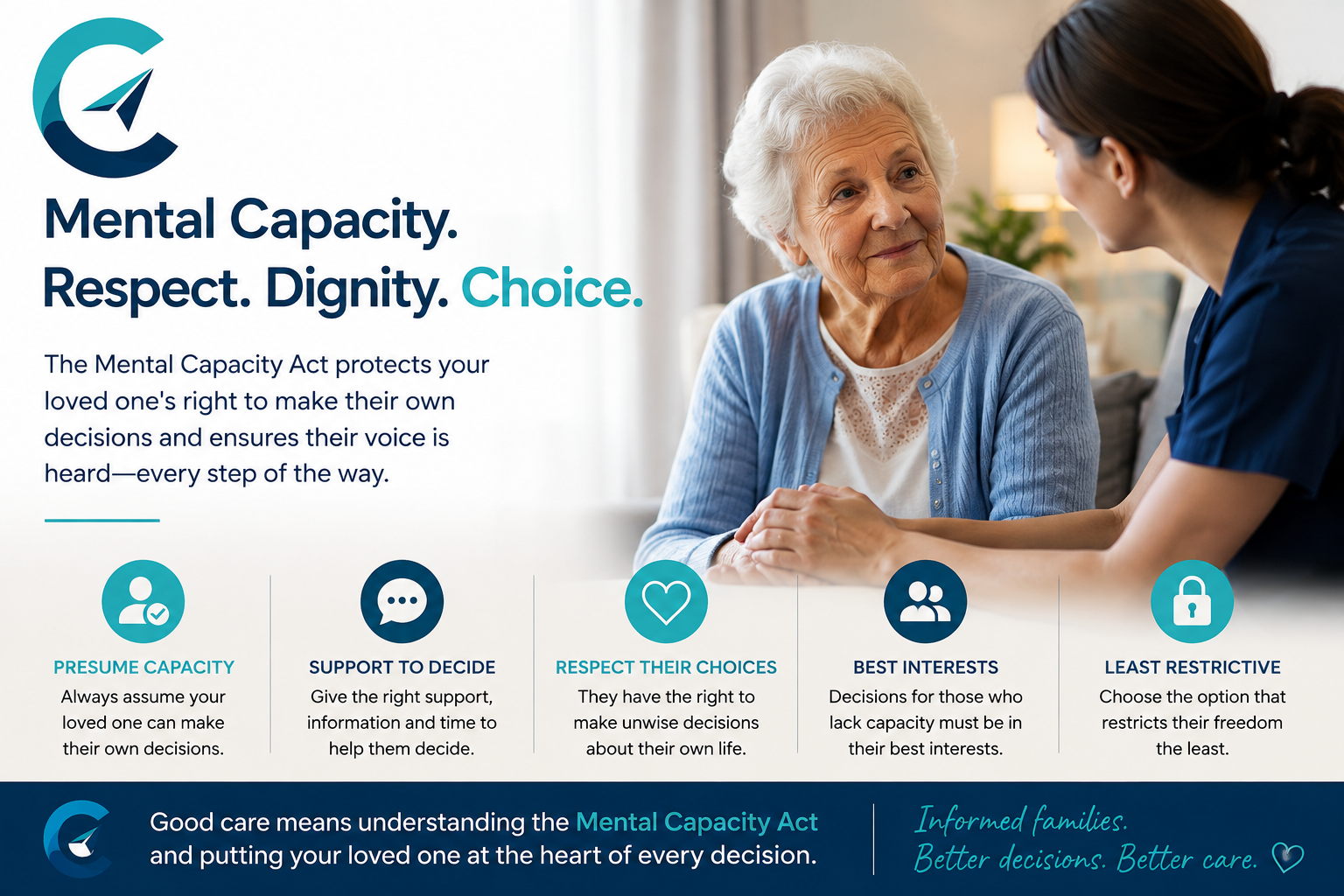
When someone moves into a care home or begins receiving care at home, families often assume that professionals will automatically know what is best. Most of the time, they do. But there is one piece of legislation that should underpin almost every decision made about a person’s care: the Mental Capacity Act 2005 (MCA).

Understanding the Mental Capacity Act can help families recognise good care, ask the right questions, and ensure their loved one is treated with dignity and respect.
What is the Mental Capacity Act?
The Mental Capacity Act applies to everyone aged 16 and over in England and Wales. It exists to protect people who may struggle to make some decisions because of conditions such as:
- Dementia
- Stroke
- Brain injury
- Learning disabilities
- Delirium caused by illness or infection
- Mental illness
- Temporary confusion caused by medication or illness
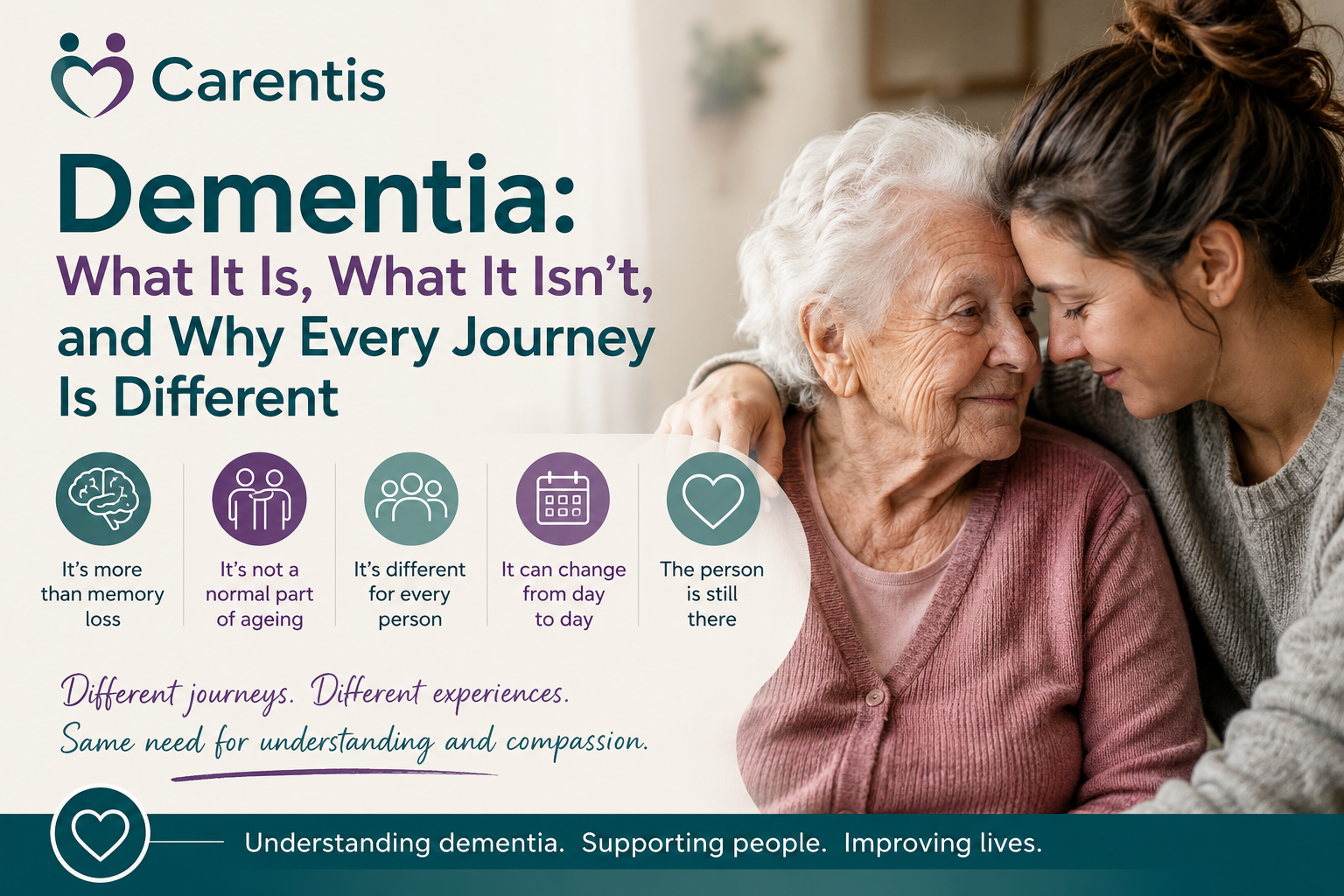
Importantly, having one of these conditions does not automatically mean someone lacks capacity.
Capacity is decision-specific. A person may be able to decide what they want for lunch but be unable to understand a complex financial decision.
The Five Principles of the Mental Capacity Act
Every professional should know these principles.
1. Assume capacity unless proven otherwise
Nobody should be treated as unable to make decisions simply because they have dementia or another diagnosis.
Capacity must never be judged on age, appearance or disability.
2. Support people to make their own decisions
Before deciding someone lacks capacity, every reasonable effort should be made to help them decide.
This may include:
- Choosing a quieter environment
- Explaining information more simply
- Using pictures or written information
- Giving extra time
- Waiting until pain or infection has improved
- Using hearing aids or glasses
3. People are allowed to make unwise decisions
Making a decision others disagree with does not mean someone lacks capacity.
Someone might choose to:
- Refuse medication
- Eat unhealthy food
- Spend money unwisely
- Remain at home despite risks
Professionals should only question capacity if the person cannot understand or weigh the information—not simply because they disagree with the decision.
4. Decisions must be in the person’s best interests
If someone genuinely lacks capacity, decisions must be made in their best interests.
This is not simply what professionals think is safest.
Best interests involve considering:
- The person’s past wishes
- Their current wishes
- Religious and cultural beliefs
- Values they have always held
- Family views
- Less restrictive alternatives
5. Choose the least restrictive option
Whenever possible, care should interfere as little as possible with a person’s freedom.
Sometimes there are several safe options. The least restrictive one should usually be chosen.
How Is Capacity Assessed?
Capacity assessments should answer four questions.
Can the person:
- Understand the relevant information?
- Retain it long enough to decide?
- Weigh up the pros and cons?
- Communicate their decision?
If they cannot do one or more of these because of an impairment of the mind or brain, they may lack capacity for that specific decision.
Consent in Everyday Care
Families are often surprised how many everyday activities require consent.
Examples include:
- Personal care
- Washing and dressing
- Medication
- Physiotherapy
- Blood tests
- Medical examinations
- Photographs
- Sharing information with relatives
- Moving bedrooms
- Hospital appointments
If someone has capacity, their consent must always be sought, even if the family disagrees.
If Someone Lacks Capacity
Care should not simply continue because “they have dementia.”
Instead, staff should:
- Complete a capacity assessment.
- Record why capacity is lacking.
- Hold a best interests discussion where appropriate.
- Consider involving family.
- Record the final decision and why it is in the person’s best interests.
The Role of Families
One of the biggest misunderstandings is that relatives automatically make decisions.
Legally, this is not usually the case.
Unless someone has:
- A Health and Welfare Lasting Power of Attorney, or
- A Court of Protection Deputyship (which is rare for health decisions),
family members do not have legal authority to make decisions.
However, they often know the person better than anyone else and should usually be consulted when best interest decisions are made.
Questions Families Should Ask
If your relative appears unable to consent, don’t be afraid to ask:
- Has a Mental Capacity Assessment been completed?
- What decision was it for?
- Why was it decided they lacked capacity?
- How were they supported to make the decision?
- Was a best interests decision made?
- Was the least restrictive option considered?
- How were the family’s views taken into account?
- Has this been documented?
Good care providers should welcome these questions.
Red Flags Families Should Watch For
While most care providers follow the law carefully, warning signs include:
- Staff saying, “They’ve got dementia, so they can’t consent.”
- Decisions being made without any discussion.
- No evidence of capacity assessments.
- Family never being consulted when appropriate.
- Restrictive practices being introduced without explanation.
- Staff saying, “We always do it this way.”
These may suggest the Mental Capacity Act is not being applied correctly.
Consent Is an Ongoing Process
Capacity can change.
Someone may lack capacity during an infection but regain it once they recover.
Someone with dementia may have capacity in the morning but struggle later in the day.
This means assessments should be reviewed whenever circumstances change, rather than assuming someone will never regain the ability to decide.
The Bottom Line
The Mental Capacity Act is not just a legal requirement—it is about respecting people’s rights, dignity and independence.
Good care means involving people in decisions for as long as they are able, supporting them when they need help, and making thoughtful, well-documented best interest decisions only when necessary.
Families who understand these principles are better equipped to advocate for their loved ones and to recognise care that truly puts the individual at the centre of every decision.