
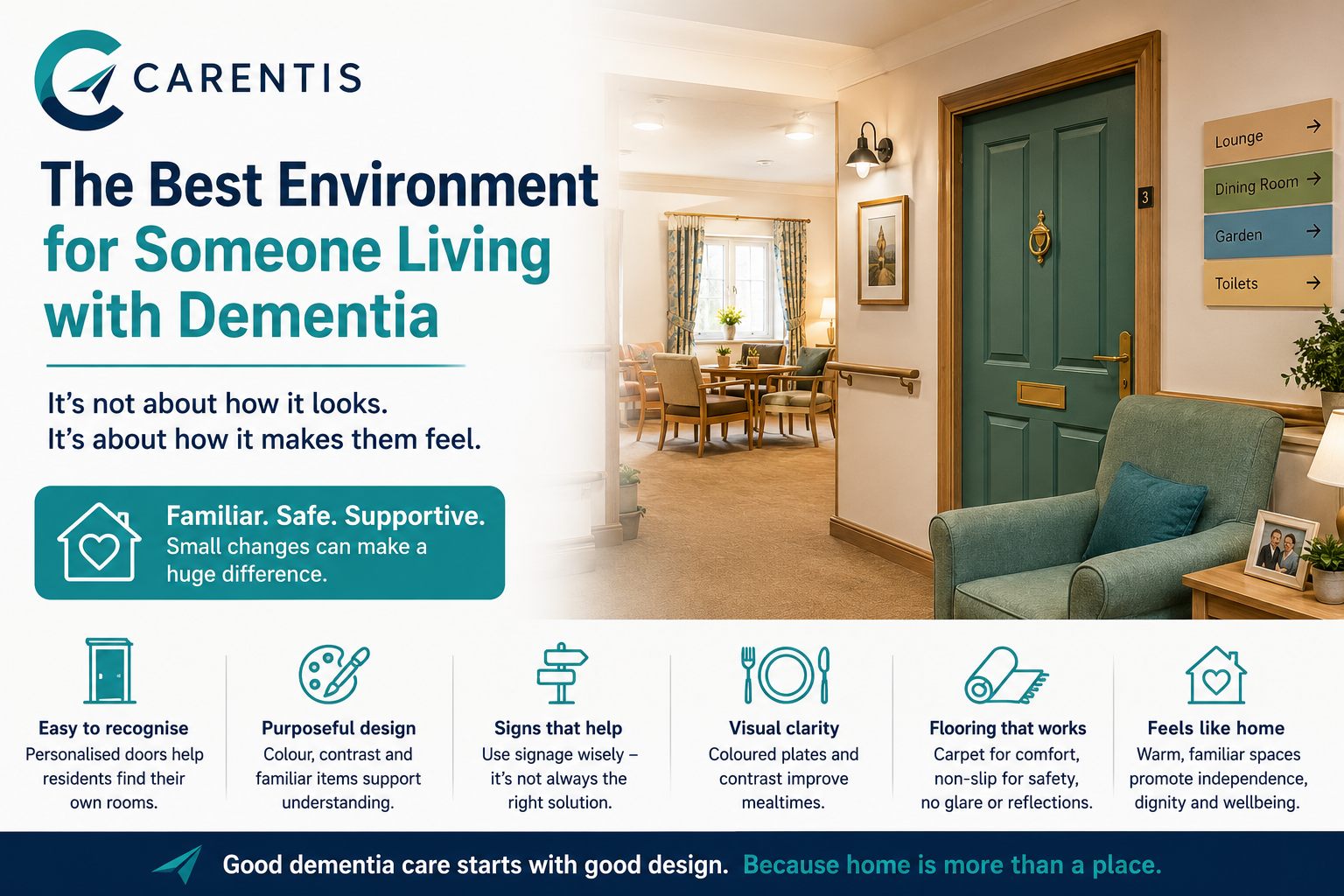
Walk into a modern care home brochure and you’ll often see hotel-style lounges, shiny floors, designer furniture and elegant décor.
It looks impressive.
But the real question is this:
Is it designed for the people living there, or for the people choosing it?
There is a huge difference.
As someone who has spent years managing care homes, I’ve seen many expensive design features that look fantastic to visitors but make life harder for residents with dementia. Equally, I’ve seen simple changes make an enormous difference to confidence, independence and wellbeing.
It Should Feel Like Home, Not a Hotel
Many providers compete to build the most luxurious-looking home.
- Marble reception desks.
- Boutique hotel furniture.
- Designer lighting.
- Minimalist décor.
The problem is that most people moving into a care home with dementia grew up in homes that looked nothing like this.
Familiar surroundings reduce anxiety.
A cosy lounge with comfortable armchairs, books, family photographs and ornaments often feels safer than a room that looks like the lobby of a four-star hotel.
Luxury should never come at the expense of familiarity.
Bedroom Doors Should Be Easy to Recognise
One of the biggest challenges for someone with dementia is finding their own room.
A long corridor of identical white doors can be confusing and frightening.
Research and practical experience both suggest residents find their rooms more easily when doors are personalised.
Some homes use:
- Front door-style bedroom doors
- Individual colours
- Letterboxes
- Door knockers
- Memory boxes containing family photographs and treasured items
- House numbers or names
These simple features help residents maintain independence for much longer.
Beware of Overusing “Dementia” Signage
Bright yellow signs saying:
TOILET
DINING ROOM
or displaying large dementia symbols are common.
They certainly help some people.
But they aren’t always the answer.
Signs only work if someone can still understand language.
As dementia progresses, recognition becomes more visual than verbal.
Sometimes colour, lighting, familiar landmarks and thoughtful layout are more effective than simply adding another sign.
Good dementia design doesn’t rely solely on labels.
Plain Walls Aren’t Always Better
You’ll often hear that dementia environments should be plain to reduce confusion.
That isn’t entirely true.
Walls don’t need to be empty.
The key is avoiding visual clutter while still providing interest.
Residents benefit from:
- Familiar pictures
- Local landmarks
- Historic photographs
- Seasonal displays
- Areas that encourage conversation
These create opportunities for reminiscence without becoming overwhelming.
Do Coloured Plates Really Help?
Often, yes.
Many people with dementia struggle to distinguish white food on a white plate.
Using high-contrast plates—such as blue, red or green—can make meals easier to see and encourage better food intake.
The same principle applies to cups and cutlery.
Good nutrition sometimes starts with better design.
Carpet or Laminate?
This is one of the most debated topics.
Carpet
Carpet tends to:
- Reduce noise
- Feel warmer
- Create a more homely atmosphere
- Reduce echo, which can increase confusion
Laminate
Laminate is:
- Easier to clean
- Better for infection control
- More durable in high-traffic areas
However, highly reflective flooring can sometimes appear wet or like a hole to someone with dementia, making them reluctant to walk across it.
Strong patterns can also be misinterpreted as steps, objects or obstacles.
For many dementia environments, good-quality, matte-finish carpet in living areas provides the best balance between comfort and orientation, while specialist non-reflective vinyl is often more appropriate in bathrooms and clinical areas.
The Best Dementia Environment Is Almost Invisible
The most successful dementia-friendly homes rarely shout about being dementia friendly.
Instead, they quietly remove barriers.
Residents know where they are.
They can find their room.
They feel safe walking around.
They recognise familiar surroundings.
They eat well.
They remain independent for longer.
That’s what really matters.
Because the best dementia environment isn’t the one that impresses visitors.
It’s the one that allows someone living with dementia to keep living their life with confidence, dignity and as much independence as possible.