
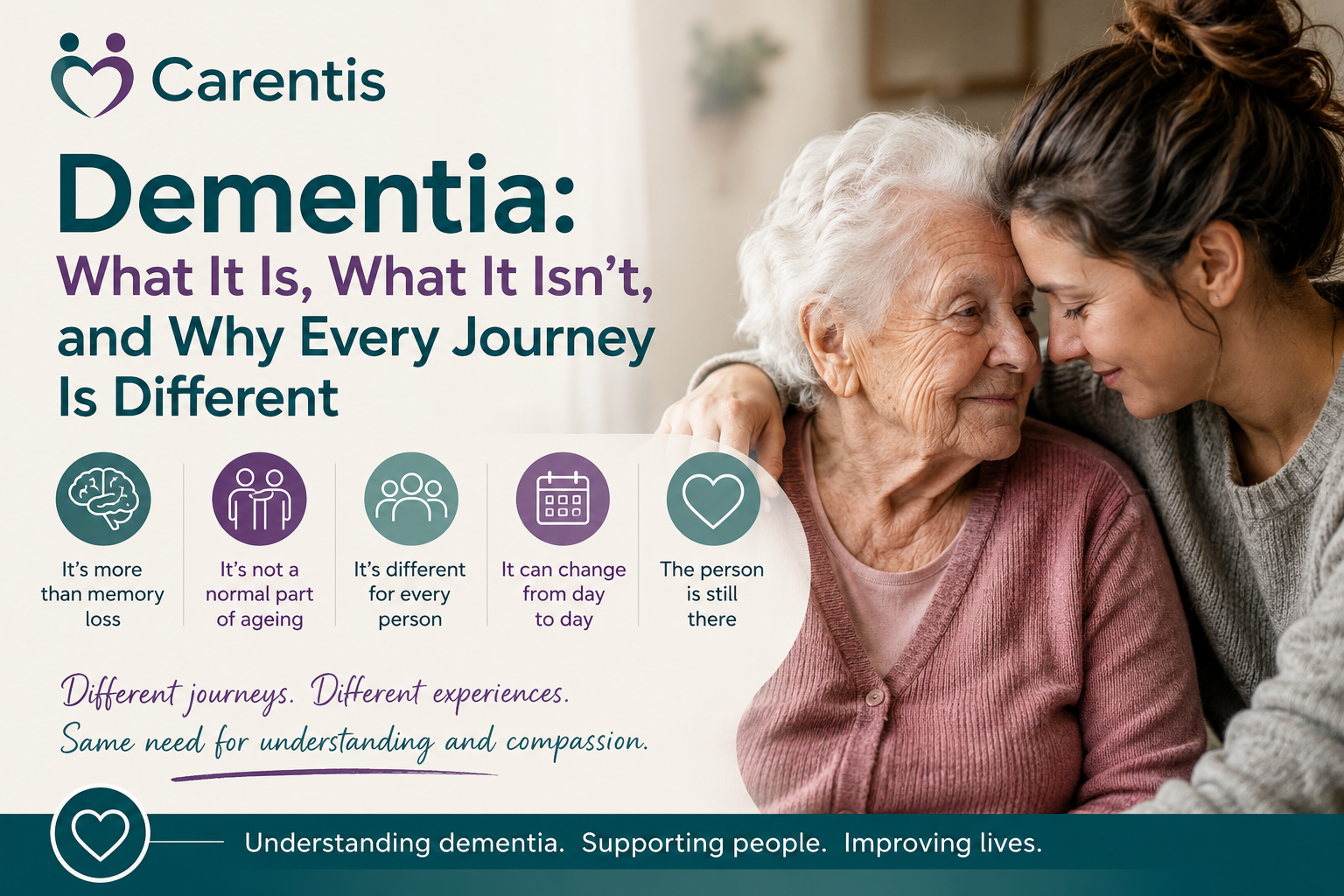
One of the biggest misconceptions about dementia is that it’s a single disease with a predictable path. It isn’t.
In reality, dementia is an umbrella term describing a collection of symptoms caused by diseases affecting the brain. Just as no two people are the same, no two experiences of dementia are the same either.
Understanding what dementia is—and just as importantly, what it isn’t—can make an enormous difference to how we support people living with it.
What Dementia Is
Dementia is a syndrome caused by damage to the brain. That damage affects how the brain processes information, stores memories, communicates and controls behaviour.
The symptoms usually develop gradually and worsen over time, but the speed and pattern can vary enormously.
Common symptoms include:
- Problems with short-term memory
- Difficulty finding words or following conversations
- Confusion about time or place
- Changes in judgement and decision-making
- Problems completing familiar tasks
- Changes in mood, personality or behaviour
These symptoms become significant enough to interfere with daily life.
What Dementia Isn’t
It isn’t a normal part of ageing
Many people become slightly more forgetful as they get older. Misplacing your glasses or forgetting why you walked into a room isn’t dementia.
Dementia goes beyond ordinary ageing. It progressively affects independence, reasoning and everyday functioning.
It isn’t just memory loss
People often think dementia simply means forgetting names or repeating questions.
Memory problems are only one part of the condition.
Some people first experience:
- Visual perception problems
- Difficulty planning tasks
- Changes in language
- Personality changes
- Hallucinations
- Problems with movement or balance
In some types of dementia, memory isn’t even the first symptom.
It isn’t the same for everyone
Perhaps the biggest myth is that everyone with dementia follows the same journey.
They don’t.
There Are Many Different Types of Dementia
Alzheimer’s disease is the most common, but there are many others, including:
- Vascular dementia
- Lewy body dementia
- Frontotemporal dementia
- Mixed dementia
Each affects different areas of the brain, producing different symptoms.
Someone with frontotemporal dementia may have major personality changes while their memory remains relatively good.
Someone with Lewy body dementia may experience vivid hallucinations and fluctuations in alertness.
Someone with vascular dementia may experience a stepwise decline following strokes or reduced blood flow to the brain.
No single description fits everyone.
Every Person Is Different
Even two people diagnosed with the same type of dementia can have completely different experiences.
Factors that influence someone’s journey include:
- Which parts of the brain are affected
- Their age
- Other medical conditions
- Their personality before dementia
- Their physical health
- Their social support
- Their environment
One person may remain independent for years.
Another may need support much sooner.
Neither experience is “typical”—they’re simply different.
Symptoms Can Change Day to Day
Families are often surprised that someone can seem “back to normal” one day and very confused the next.
This doesn’t necessarily mean the diagnosis is wrong.
Fatigue, infections, pain, unfamiliar surroundings, dehydration, anxiety and poor sleep can all temporarily worsen dementia symptoms.
That’s why it’s important to look beyond the diagnosis and ask:
“What might be causing this change today?”
The Person Is Still There
One of the most damaging misconceptions is that dementia means someone has “gone.”
The disease changes how a person communicates, remembers and understands the world.
But emotions often remain incredibly strong.
People with dementia still experience:
- Love
- Fear
- Happiness
- Loneliness
- Comfort
- Anxiety
- Humour
Even when words become difficult, people continue to respond to kindness, reassurance, music, familiar voices and meaningful relationships.
Good Care Is Personal
Because every dementia journey is different, good care should never rely on a checklist alone.
The best care starts with understanding the individual.
Questions that matter include:
- What was important to this person before dementia?
- What routines help them feel safe?
- What music do they enjoy?
- What worries them?
- What makes them smile?
- How do they usually communicate when they’re frightened or in pain?
The answers to these questions are often far more valuable than simply knowing the diagnosis.
The Bottom Line
Dementia is not one disease, one set of symptoms or one predictable journey.
It is a collection of conditions that affect each person differently.
The diagnosis may be shared by millions, but the experience is unique to every individual.
The more we move away from stereotypes and towards understanding the person behind the diagnosis, the better the care we can provide—and the better quality of life we can help preserve for both people living with dementia and those who love them.