
One of the hardest things for families to understand is why someone with dementia can remember events from 60 years ago but not recognise a visitor from yesterday.
The answer lies in how dementia affects the brain.
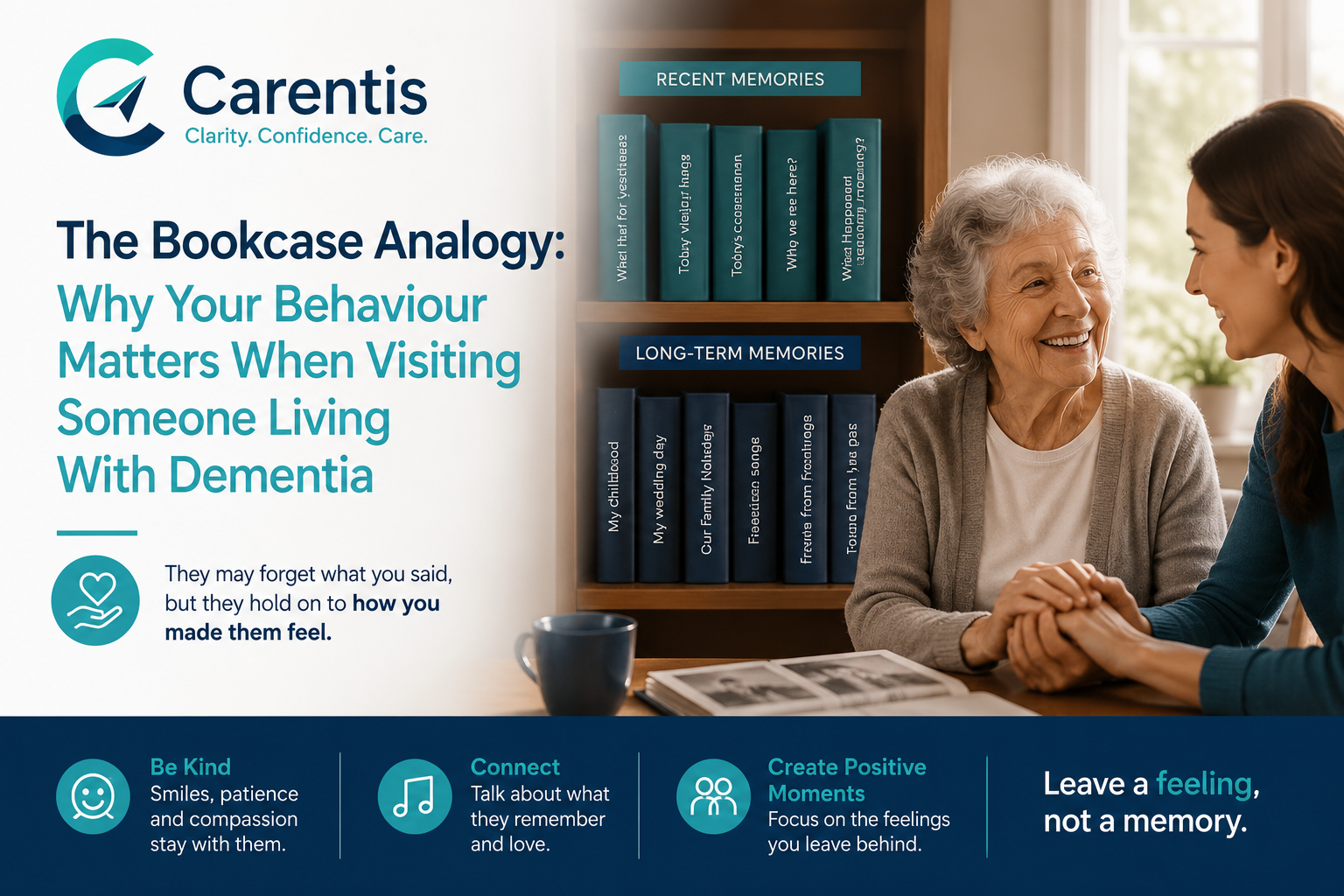
One of the simplest ways to explain it is to imagine your memory as a giant bookcase.
Your Memory Is Like a Bookcase
Throughout your life, every memory is placed on a shelf.
Your first day at school.
Your wedding.
The birth of your children.
Your favourite songs.
How to make a cup of tea.
The names of friends.
What happened this morning.
When you’re healthy, you can reach almost any book whenever you need it.
Some take a little longer to find than others, but they’re all there.
Dementia Doesn’t Empty the Bookcase Overnight
With dementia, the books don’t suddenly disappear.
Instead, it becomes harder and harder to reach the books on the top shelves.
These are your newest memories.
What you had for breakfast.
Who visited yesterday.
Why you’ve come into this room.
The conversation you had five minutes ago.
As the disease progresses, those books become increasingly difficult to access.
Meanwhile, the books on the lower shelves—your oldest memories—often remain much easier to reach.
That’s why someone may vividly remember dancing with their husband in the 1960s but be unable to remember that he died several years ago.
They may tell stories from childhood with remarkable detail while asking the same question every few minutes.
This isn’t stubbornness.
It isn’t laziness.
It isn’t because they’re “not trying.”
It’s because the pathways to those newer memories have been damaged.
Why This Changes How We Should Visit
Many families unintentionally turn every visit into a memory test.
“Do you know who I am?”
“Remember, I was here yesterday.”
“I’ve already told you that.”
“No Mum, that’s wrong.”
Although these comments are usually well-intentioned, they can create anxiety, embarrassment and frustration.
Imagine being repeatedly reminded that your brain isn’t working as it used to.
Instead of testing memory, focus on creating a positive experience.
Join them in their reality.
Talk about the things they remember.
Listen to their stories, even if you’ve heard them a hundred times.
Look through old photographs.
Play music from their younger years.
Hold their hand.
Smile.
Laugh together.
They May Forget the Visit…
One of the saddest things families say is:
“What’s the point in visiting? They’ll only forget I was there.”
It’s true that they may not remember you visited.
They may not remember what you talked about.
They may not remember what you wore.
But they often remember something far more important.
The feeling you left behind.
If your visit made them feel safe, loved, calm and valued, those emotions can remain long after the details have faded.
Likewise, if a visit leaves them feeling criticised, frightened or confused, those emotions may linger too—even when they can’t remember why.
Leave a Feeling, Not a Memory
When visiting someone living with dementia, don’t measure the success of your visit by whether they remember your name or the conversation.
Measure it by how they felt while you were there.
Did they smile?
Did they laugh?
Did they seem relaxed?
Did they feel loved?
Those moments matter.
Because although dementia may make the books on the top shelf difficult to reach, kindness, compassion and human connection still have the power to make someone’s day better.
And sometimes, that’s the greatest gift you can give.
One of the hardest things for families to understand is why someone with dementia can remember events from 60 years ago but not recognise a visitor from yesterday.
The answer lies in how dementia affects the brain.
One of the simplest ways to explain it is to imagine your memory as a giant bookcase.
Your Memory Is Like a Bookcase
Throughout your life, every memory is placed on a shelf.
Your first day at school.
Your wedding.
The birth of your children.
Your favourite songs.
How to make a cup of tea.
The names of friends.
What happened this morning.
When you’re healthy, you can reach almost any book whenever you need it.
Some take a little longer to find than others, but they’re all there.
Dementia Doesn’t Empty the Bookcase Overnight
With dementia, the books don’t suddenly disappear.
Instead, it becomes harder and harder to reach the books on the top shelves.
These are your newest memories.
What you had for breakfast.
Who visited yesterday.
Why you’ve come into this room.
The conversation you had five minutes ago.
As the disease progresses, those books become increasingly difficult to access.
Meanwhile, the books on the lower shelves—your oldest memories—often remain much easier to reach.
That’s why someone may vividly remember dancing with their husband in the 1960s but be unable to remember that he died several years ago.
They may tell stories from childhood with remarkable detail while asking the same question every few minutes.
This isn’t stubbornness.
It isn’t laziness.
It isn’t because they’re “not trying.”
It’s because the pathways to those newer memories have been damaged.
Why This Changes How We Should Visit
Many families unintentionally turn every visit into a memory test.
“Do you know who I am?”
“Remember, I was here yesterday.”
“I’ve already told you that.”
“No Mum, that’s wrong.”
Although these comments are usually well-intentioned, they can create anxiety, embarrassment and frustration.
Imagine being repeatedly reminded that your brain isn’t working as it used to.
Instead of testing memory, focus on creating a positive experience.
Join them in their reality.
Talk about the things they remember.
Listen to their stories, even if you’ve heard them a hundred times.
Look through old photographs.
Play music from their younger years.
Hold their hand.
Smile.
Laugh together.
They May Forget the Visit…
One of the saddest things families say is:
“What’s the point in visiting? They’ll only forget I was there.”
It’s true that they may not remember you visited.
They may not remember what you talked about.
They may not remember what you wore.
But they often remember something far more important.
The feeling you left behind.
If your visit made them feel safe, loved, calm and valued, those emotions can remain long after the details have faded.
Likewise, if a visit leaves them feeling criticised, frightened or confused, those emotions may linger too—even when they can’t remember why.
Leave a Feeling, Not a Memory
When visiting someone living with dementia, don’t measure the success of your visit by whether they remember your name or the conversation.
Measure it by how they felt while you were there.
Did they smile?
Did they laugh?
Did they seem relaxed?
Did they feel loved?
Those moments matter.
Because although dementia may make the books on the top shelf difficult to reach, kindness, compassion and human connection still have the power to make someone’s day better.
And sometimes, that’s the greatest gift you can give.