
Understanding the assessment before it happens
When someone you love has increasing care needs, it’s easy to feel overwhelmed.
You may have heard about NHS Continuing Healthcare (CHC), only to find conflicting advice online. Some people say nobody qualifies. Others promise guaranteed success if you pay for representation. The reality sits somewhere in the middle.
NHS Continuing Healthcare exists to ensure that people whose primary need is a health need receive care funded by the NHS rather than paying for it themselves. For some families, this can mean the difference between paying substantial care fees and receiving fully funded care.
The challenge is that CHC assessments can feel confusing, technical and, at times, intimidating. Families often attend meetings without understanding how decisions are reached or what evidence assessors are actually looking for.
At Carentis, we don’t provide legal advice or guarantee outcomes.
Instead, we provide practical guidance based on years of experience working in nursing and senior care home management, participating in Continuing Healthcare assessments, contributing to Decision Support Tool (DST) meetings and reviewing the evidence that informs recommendations.
Understanding the process won’t guarantee eligibility—but it can help ensure the person’s needs are understood more accurately.
What is NHS Continuing Healthcare?
One of the biggest misconceptions about CHC is that eligibility depends on diagnosis.
It doesn’t.
A diagnosis of dementia, Parkinson’s disease, multiple sclerosis or cancer doesn’t automatically mean someone will qualify. Equally, not having one of these conditions doesn’t automatically rule someone out.
The assessment considers how a person’s health needs affect their daily life. It looks at the nature, intensity, complexity and unpredictability of those needs and whether, taken as a whole, they amount to a primary health need.
The decision should always be evidence-led.
That’s why understanding the evidence is often more important than understanding the diagnosis.
The biggest mistake families make
This is probably the single most common issue I have seen over the years.
Families understandably describe the person they love on a good day.
They tell the assessor:
“Mum has been much better recently.”
or
“Dad’s having a good morning today.”
The problem is that Continuing Healthcare isn’t about someone’s best day.
It’s about understanding the reality of their needs over time.
If someone usually refuses medication, but accepted it this morning, that refusal still matters.
If they normally require two members of staff to support them because of falls risk, but happened to mobilise well today, the ongoing risk hasn’t disappeared.
If confusion varies throughout the day, the assessment should reflect the overall pattern—not a single snapshot.
Good days provide context.
Difficult days often provide evidence.
What assessors are really looking for
Families sometimes imagine the assessment is a checklist where points are added together until someone qualifies.
It isn’t that simple.
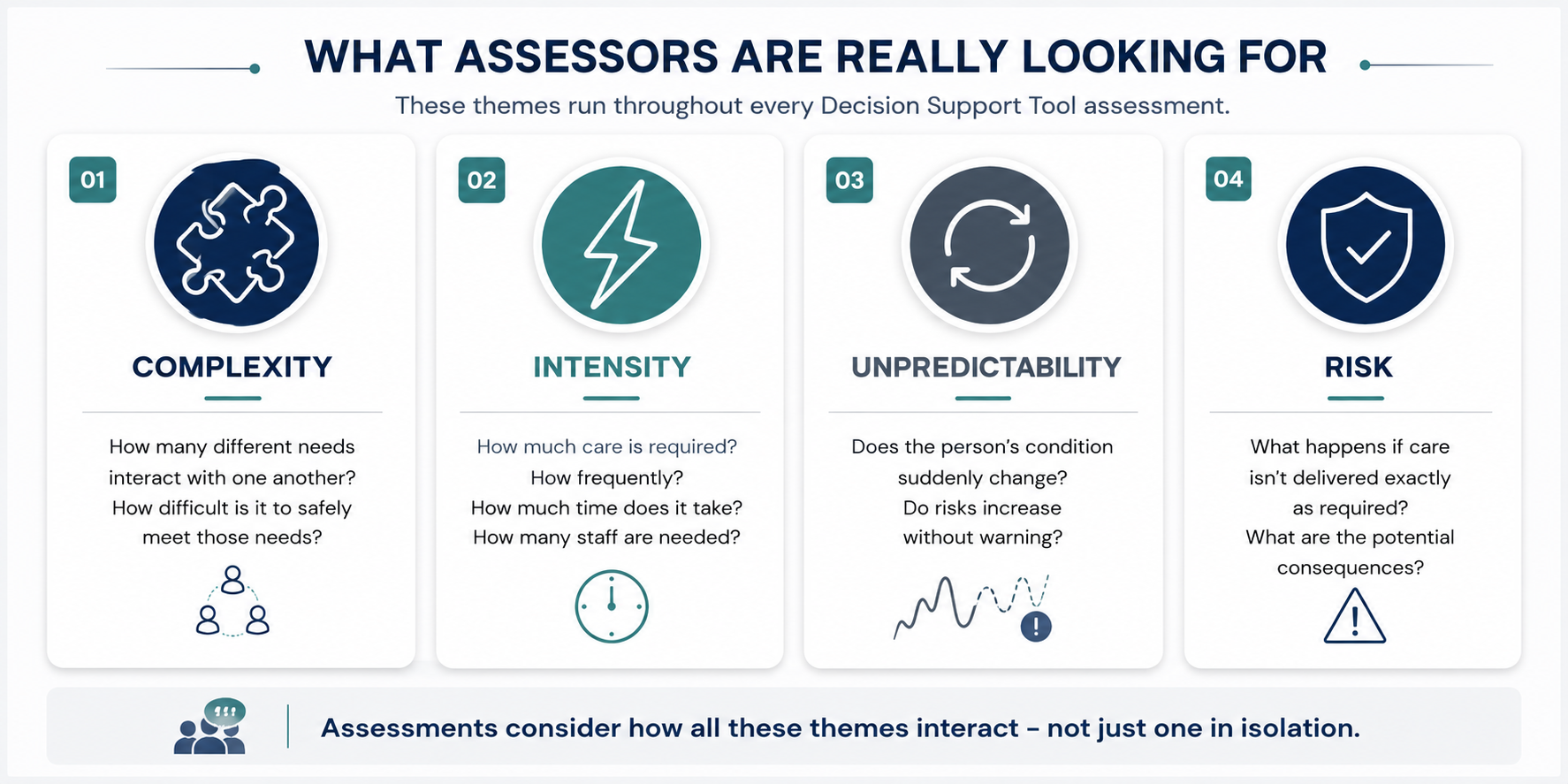
The discussion throughout the Decision Support Tool centres around four important themes.
Complexity
How many different health needs interact with one another?
Someone may have diabetes, dementia, Parkinson’s disease and swallowing difficulties. Each condition creates its own challenges, but together they may significantly increase the complexity of care.
Assessors consider how these needs combine rather than viewing each condition in isolation.
Intensity
How much care is required?
How frequently?
How much time does it take?
Does the person require one member of staff or two?
Is care needed throughout the day and night?
Intensity isn’t simply about how serious a condition sounds. It’s about the amount of skilled support required to manage it safely.
Unpredictability
Some people remain relatively stable.
Others can deteriorate quickly or unexpectedly.
Perhaps someone becomes aggressive without warning.
Perhaps blood sugar levels fluctuate significantly.
Perhaps they choke despite careful supervision.
Perhaps seizures occur unpredictably.
Unexpected changes often increase the risks faced by both the individual and those caring for them.
Risk
This question sits behind almost every discussion.
What happens if the care isn’t provided?
Would the person fall?
Miss medication?
Become distressed?
Develop pressure damage?
Become dehydrated?
Leave the building?
Understanding the potential consequences of unmet need is often just as important as describing the care itself.
The evidence matters more than opinions
One of the biggest surprises for many families is how much of the discussion is based on written records.
Assessors aren’t simply listening to what relatives say on the day.
They are reviewing evidence built up over weeks and months.
That evidence often includes:
- Care plans
- Daily care records
- Medication administration records
- Risk assessments
- Falls records
- Incident reports
- Behaviour monitoring
- Nutritional assessments
- Weight charts
- Clinical observations
If these records don’t accurately reflect the person’s needs, the assessment may not reflect them either.
Ask for the records
Many families don’t realise they can ask to see the records being used to assess their relative.
It’s worth requesting copies well before any assessment if possible.
Reading the records gives you an opportunity to understand how the person’s needs have been documented and whether anything appears to have been missed.
Remember, care homes are busy environments.
Care staff work incredibly hard, but documentation sometimes focuses on tasks completed rather than explaining the complexity behind those tasks.
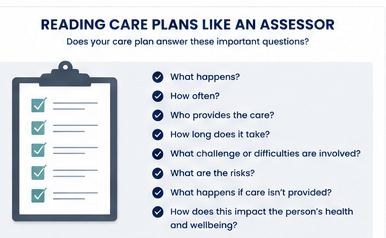
Read the care plans like an assessor
When most people read a care plan, they ask:
“Is this accurate?”
Instead, try asking:
Does it explain why support is needed?
Does it explain what happens if support isn’t provided?
Does it explain how often support is required?
Does it explain how much intervention staff provide?
Does it explain the risks involved?
Those questions often reveal far more than simply checking whether the facts are correct.
Five signs a care plan isn’t telling the whole story
“Requires assistance.”
With what?
How much?
How often?
From whom?
“Can become distressed.”
What does distressed actually look like?
Is the person tearful?
Verbally aggressive?
Physically aggressive?
Trying to leave?
Refusing care?
The detail matters.
“Mobilises with assistance.”
One member of staff?
Two?
Walking frame?
Hoist?
How far?
How often?
What are the risks?
“Occasionally refuses medication.”
Occasionally could mean once a month.
Or twice every day.
Specific evidence is always stronger than vague descriptions.
“Personal care provided.”
How long does this take?
Is reassurance needed?
Does the person resist?
Is pain involved?
Does care require two members of staff?
The task itself is often less important than the complexity of delivering it safely.
Understanding the Decision Support Tool (DST)
The Decision Support Tool considers twelve areas of need, known as care domains.
Each domain explores different aspects of the person’s health and care requirements before the multidisciplinary team reaches an overall recommendation.
Although each domain is important, the final recommendation isn’t simply based on adding scores together.
The discussion considers how the different needs interact and whether, taken together, they indicate a primary health need.
Understanding this distinction helps explain why two people with apparently similar scores may receive different recommendations.
If the recommendation doesn’t feel right
Receiving a negative recommendation can feel deeply frustrating.
Sometimes the evidence genuinely supports the outcome.
Sometimes families leave feeling that important information wasn’t fully reflected in the discussion.
Appeals exist because the assessment process recognises that decisions can be challenged where there are reasonable grounds to do so.
Strong appeals are usually built on evidence rather than emotion.
They identify where records have been overlooked, where risks have been underestimated or where the Decision Support Tool doesn’t appear to reflect the evidence discussed during the assessment.
Continue your learning
This page provides an introduction to NHS Continuing Healthcare, but there’s far more to understand if you’re preparing for an assessment or considering an appeal.
Our comprehensive guide has been written to help families understand the process before important decisions are made.
Inside you’ll learn:
- How the Checklist and DST work
- How to prepare before the assessment
- What assessors are really looking for
- How to review care plans effectively
- How to identify gaps in evidence
- How to document someone’s “worst day”
- Questions to ask during the assessment
- Understanding the twelve care domains
- Reviewing a completed DST
- Challenging decisions professionally
- Preparing for an appeal
- Practical checklists and templates you can use immediately
Why trust Carentis?
Carentis was created to make complex adult social care information easier to understand.
The guidance is based on years of frontline experience in nursing and senior care home leadership, including participating in Continuing Healthcare assessments and working with the care records that underpin many funding decisions.
We don’t provide legal advice or promise outcomes. Our aim is to help families feel informed, prepared and confident when navigating one of the most important processes in adult social care.